Art, Stillness, and Soul: Wandering Hiroshima’s Hidden Cultural Corners
You know that feeling when a place quietly changes you? Hiroshima did that for me. Beyond its resilient spirit, I discovered serene temples, intimate galleries, and living traditions that unfold only when you slow down. This isn’t a city to rush through—it’s one to feel, one quiet alley, handcrafted tea bowl, and local smile at a time. Slow travel here isn’t just a style—it’s the only way to truly see. In a world that prizes speed, Hiroshima offers a different rhythm: one measured in the soft chime of temple bells, the careful brushstroke of a ceramic glaze, and the shared silence between strangers who meet with kindness. It is a city shaped by history, yet alive with quiet creativity and enduring grace.
The Rhythm of Slow Travel in a Modern City
Hiroshima is often approached with reverence, and rightly so. Many visitors arrive with a sense of duty—to witness, to remember, to pay respects. While these intentions are deeply meaningful, they can unintentionally shape a hurried or narrowly focused journey. The Peace Memorial Park and Museum are essential, powerful spaces that demand contemplation. But to stop there is to see only one layer of a city that has grown, healed, and quietly reinvented itself through decades of resilience. The true depth of Hiroshima reveals itself not in minutes, but in moments stretched out over hours: the pause before entering a neighborhood shrine, the time spent watching an elderly woman arrange seasonal flowers by her doorway, the unhurried exchange at a corner tea shop where no words are needed.
Slow travel, in this context, is not merely a trend or a luxury—it is a form of respect. It is the understanding that a place shaped by profound loss deserves more than a checklist. It asks travelers to move with intention, to listen more than they speak, and to allow space for unexpected encounters. In Hiroshima, this pace allows you to notice the subtle ways culture lives on: in the precise geometry of a paper lantern hanging in a backstreet window, in the way sunlight filters through bamboo groves near a lesser-known temple, in the quiet pride with which a local chef flips an okonomiyaki on a well-worn griddle. These are not attractions; they are fragments of daily life, and they only emerge when you are still enough to see them.
Contrast this with the typical tourist itinerary—arrive by bullet train, visit the Peace Park, snap a photo of the Atomic Bomb Dome, take a day trip to Miyajima, depart. Efficient, perhaps, but incomplete. By rushing, one risks reducing a complex, living city to a series of symbolic sites. Slow travel restores balance. It encourages staying longer in one neighborhood, returning to the same café, learning the name of the shopkeeper. It means wandering without GPS, allowing yourself to get slightly lost in the grid of narrow streets where laundry flutters between buildings and the scent of grilled fish drifts from open kitchen doors. In these unscripted moments, Hiroshima begins to breathe around you, revealing its soul not through grand gestures, but through quiet consistency.
Art That Breathes: Hiroshima’s Living Creative Scene
Art in Hiroshima does not shout; it whispers. It is not confined to white-walled galleries but lives in workshops, family-run ateliers, and the hands of artisans who carry forward traditions shaped by both beauty and survival. The Hiroshima City Museum of Contemporary Art, nestled in the green embrace of Asa Park, offers a thoughtful introduction to this ethos. Its collection avoids spectacle, favoring works that explore memory, nature, and the subtleties of human emotion. Paintings with restrained palettes, sculptures formed from weathered wood or smooth river stone—these pieces echo the city’s aesthetic: one of restraint, resilience, and quiet depth.
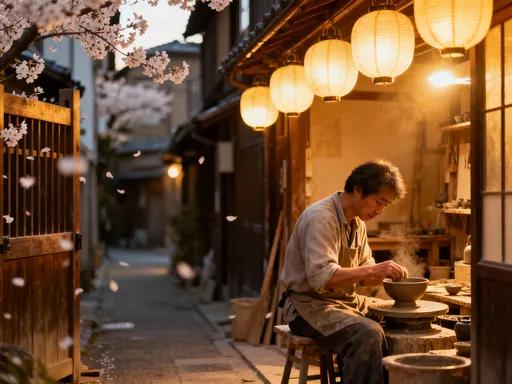
Yet the museum is only a starting point. The real pulse of Hiroshima’s creative spirit beats in smaller, less visible spaces. In the Kamiyacho district, tucked between modern cafes and bookstores, you’ll find independent studios where artists work in mediums passed down through generations. One such craft is Hiroshima-yaki, a form of pottery known for its delicate glazes and understated elegance. In a sunlit workshop near the Ota River, a potter shapes clay with practiced hands, explaining how each piece is fired slowly, allowing the minerals in the glaze to bloom in unpredictable ways. “We don’t control the fire,” she says with a soft smile. “We listen to it.” This philosophy—of collaboration with nature, of accepting imperfection—is central to the region’s artistic identity.
Equally profound is the tradition of ori textiles, a weaving practice that produces lightweight, breathable fabrics often used in summer kimonos. In a quiet alley near Hon-dori, a fourth-generation weaver demonstrates the loom’s rhythmic motion, the shuttle gliding back and forth like a metronome. The patterns are subtle—faint geometries, organic motifs inspired by rice fields or river currents. There is no flash, no loud statement, only a deep attention to texture and harmony. These textiles, like much of Hiroshima’s art, are not made for display cases. They are made to be worn, touched, lived in. They are art that breathes because it is part of life.
Temples, Gardens, and the Poetry of Stillness
If Hiroshima’s art speaks in whispers, its gardens speak in silence. Shukkeien Garden, whose name means “reduced-scenery garden,” is a masterpiece of intentional design and contemplative beauty. Created in the 17th century by a feudal lord, it is a miniature landscape where every element—the winding stream, the arched bridges, the carefully placed stones—carries symbolic meaning. Yet despite its historical roots, the garden feels profoundly modern in its ability to calm the mind. Walking its paths is not about seeing everything at once, but about allowing each view to unfold: a maple tree reflected in still water, a lantern half-hidden by moss, a sudden glimpse of the city skyline framed perfectly between pines.
The philosophy behind such gardens is rooted in shakkei, or “borrowed scenery”—the practice of incorporating distant views, like mountain silhouettes or temple roofs, into the garden’s composition. This blurs the boundary between the cultivated and the wild, reminding visitors that beauty exists beyond human control. Equally important is the concept of wabi-sabi, the acceptance of transience and imperfection. A cracked stone path is not repaired; a leaning pine is not straightened. These are not flaws, but features—invitations to reflect on the passage of time and the quiet dignity of aging.
Seasons shape the garden’s character in profound ways. In spring, cherry blossoms drift onto the surface of the central pond like pink snow. In autumn, the maples ignite in shades of crimson and gold, their reflections shimmering in the water. Even in winter, when the garden is spare and quiet, there is beauty in the bare branches, the frost on stone lanterns, the soft crunch of gravel underfoot. These transformations are not accidents; they are part of the design. The garden does not resist change—it celebrates it. For the slow traveler, Shukkeien is not just a place to visit, but a space to inhabit, to breathe deeply, and to remember that stillness is not emptiness, but fullness held in reserve.
Cultural Encounters in Everyday Life
Culture in Hiroshima is not locked behind glass. It is served on a hot iron griddle, wrapped in paper, shared over a low wooden table. Nowhere is this more evident than in the city’s beloved dish, okonomiyaki. Often called “Japanese pancakes,” this savory creation is far more than a meal—it is a ritual, a conversation, a canvas. Each vendor has their own method: some mix the batter directly on the grill, others pre-mix it at the counter. The ingredients vary—cabbage, pork, seafood, noodles—but the spirit remains the same: customization, care, and connection.
In a narrow stall in the Hondori Arcade, a cook works with swift, practiced movements, flipping the pancake with a pair of spatulas. “This is Hiroshima style,” he explains. “We layer the ingredients, not mix them.” The result is a tall, textured dish where each component retains its identity, yet blends into a harmonious whole—much like the city itself. As he hands over the plate, topped with zigzags of mayonnaise and savory brown sauce, he adds, “We don’t rush this. Good food takes time.” It’s a small statement, but one that resonates. In a world of fast food and instant gratification, Hiroshima’s okonomiyaki is an act of resistance—a reminder that some things cannot be hurried.
These everyday moments extend beyond food. In local markets, elderly vendors arrange radishes and daikon in neat rows, their hands weathered but precise. At neighborhood festivals, children carry paper lanterns while elders perform slow, graceful dances passed down through generations. Even a simple exchange at a convenience store—where the clerk bows slightly and says “arigatou gozaimasu” with genuine warmth—carries cultural weight. These are not performances for tourists; they are expressions of a community that values dignity, order, and quiet kindness. To witness them is to understand that culture is not something you consume—it is something you participate in, even in small ways, by being present.
Miyajima: Where Nature and Spirit Dance Together
No journey to Hiroshima is complete without a visit to Miyajima, the sacred island known formally as Itsukushima. Famous for its “floating” torii gate, which appears to rise from the sea at high tide, the island draws thousands each year. Yet beyond the postcard views lies a deeper experience—one best accessed not at midday, but in the early morning or late evening, when the crowds have thinned and the forest hums with birdsong.
The island has been considered sacred for over a thousand years, dedicated to the Shinto gods of the sea. Its atmosphere is one of balance: between land and water, between human craftsmanship and wild nature. The Great Torii is impressive, yes, but equally moving are the quieter moments—walking the forested path to Mount Misen, where sunlight dapples the moss-covered trail; sitting on the veranda of Daisho-in Temple, listening to the chime of wind bells; watching the resident deer move gracefully through the trees, unafraid yet never intrusive. These deer are considered messengers of the gods, and their presence adds to the island’s sense of otherworldly calm.
The temples and shrines of Miyajima are not grand in the way of cathedrals, but intimate and grounded. Their wooden structures, weathered by salt air and time, blend into the landscape rather than dominate it. Visitors are encouraged to walk slowly, to remove their shoes before entering, to pause and breathe. At high tide, the Otorii appears to float, a vision of harmony between structure and sea. At low tide, the gate stands on the exposed seabed, revealing the strength of its foundation—both literal and symbolic. To see it at both moments is to understand that resilience and beauty are not opposites, but companions.
For the mindful traveler, Miyajima offers a rare gift: solitude within a well-known destination. By arriving early or staying late, one can experience the island not as a checklist item, but as a living sanctuary. The absence of cars, the soft rustle of leaves, the distant call of a temple bell—all contribute to a sense of timelessness. It is a place where art, nature, and spirituality are not separate realms, but threads in the same fabric.
Practical Wisdom for a Meaningful Journey
To travel deeply in Hiroshima, certain choices make all the difference. Accommodation, for instance, should prioritize location and authenticity. Staying in the Hondori or Kamiyacho districts places you within walking distance of local shops, cafes, and cultural spaces. These neighborhoods are not tourist zones; they are lived-in, vibrant communities where daily life unfolds at a human scale. A small family-run inn or a quiet hotel with wooden interiors can enhance the sense of immersion, offering not just comfort, but continuity with the city’s rhythm.
Transportation, too, should be approached with intention. Hiroshima’s public transit system—buses and trams—is efficient, clean, and easy to navigate. Rather than renting a car, consider using the tram lines that glide through the city like quiet ribbons. The number 1 and number 3 trams connect central Hiroshima to Miyajima-guchi, where the ferry departs for the island. Riding the tram allows you to observe daily life: students in uniforms, office workers with briefcases, elders returning from morning markets. Walking, whenever possible, is even better. It slows perception, sharpens attention, and leads to discoveries no map can promise.
Respectful engagement is essential. While many locals speak basic English, learning a few phrases in Japanese—“sumimasen” (excuse me), “arigatou” (thank you), “onegaishimasu” (please)—goes a long way. When visiting temples or shrines, observe quiet behavior, avoid loud conversations, and follow local customs, such as bowing slightly before entering or washing your hands at purification fountains. When photographing people or sacred spaces, always ask permission. Supporting local artisans—by purchasing a hand-thrown tea bowl, a piece of woven fabric, or a small painting—ensures that traditional crafts continue to thrive. These acts of mindfulness are not just polite; they are forms of connection.
Why Hiroshima Changes How You Travel Forever
Leaving Hiroshima, you may find that your idea of travel has shifted. No longer is it about how many places you can see, but how deeply you can feel one. The city does not dazzle; it reveals. It does not overwhelm; it settles into your spirit like a quiet conversation remembered years later. Its lessons are subtle but lasting: that beauty often resides in restraint, that healing takes time, and that the most meaningful encounters happen when you are not rushing toward the next thing.
The imprint of Hiroshima lingers—in the way you pause before entering a new space, in your willingness to sit with silence, in your appreciation for craftsmanship that values soul over speed. It teaches you to travel not as a consumer of experiences, but as a witness, a listener, a participant. You begin to notice the quiet artistry in other places—the way light falls on a stone wall, the care in a server’s gesture, the unspoken dignity in a stranger’s eyes. These are not grand revelations, but gentle reminders that the world is full of depth, if only we move slowly enough to see it.
Hiroshima invites a different kind of journey—one of patience, openness, and reverence. It asks not that you admire it from a distance, but that you allow it to change you. And in doing so, it offers a gift far greater than memories: a new way of seeing. Not just this city, but all places. Not just travel, but life itself. In the end, the quiet alleys, the handcrafted tea bowls, the local smiles—they are not just parts of a trip. They are invitations to live more deeply, one mindful step at a time.