Taste of the Far East: Where Vladivostok’s Markets Come Alive
Walking through Vladivostok’s bustling market streets, I was hit by the scent of grilled squid, fresh sea urchin, and steaming dumplings. This port city isn’t just Russia’s gateway to the Pacific—it’s a food lover’s hidden playground. From open-air bazaars to local fish markets, every corner offers a taste of its maritime soul. You don’t just shop here—you experience flavors in motion. The rhythm of daily life pulses strongest in these vibrant marketplaces, where generations gather, cultures converge, and the sea delivers its bounty each morning. For travelers seeking authenticity beyond tourist brochures, Vladivostok’s markets offer an unfiltered glimpse into a city shaped by tides, trade, and tradition.
The Heartbeat of Vladivostok: Central Market as a Culinary Hub
The Central Market, or Tsentralny Rynok, stands as the undisputed epicenter of Vladivostok’s culinary identity. Located in the heart of the city, this covered marketplace draws locals and visitors alike with its electric atmosphere and overwhelming sensory richness. From early morning until mid-afternoon, the air hums with activity—vendors call out prices, scales click as fish are weighed, and the scent of brine, spices, and freshly baked dough fills every aisle. This is not a curated tourist attraction but a working marketplace where food is the language of connection, and every transaction feels like a small ritual of trust.
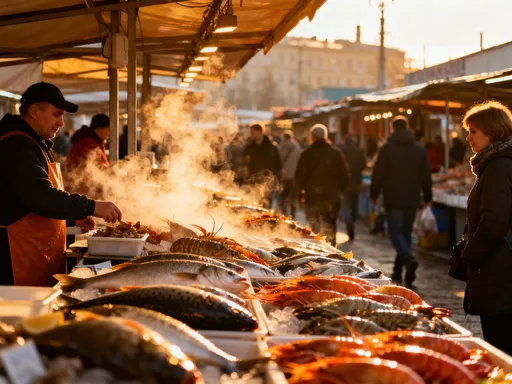
Seafood dominates the landscape here, and for good reason. Vladivostok’s position on the Sea of Japan gives it direct access to some of the most nutrient-rich waters in the North Pacific. At the fish counters, you’ll find glistening whole fish laid out on beds of crushed ice—pollock, saury, flounder, and mackerel—each labeled with its catch date and origin. More prized specimens like Pacific cod and Atka mackerel are displayed with care, often still bearing the sheen of the ocean. But the true stars are the shellfish: king crab legs stacked like timber, sea urchins cracked open to reveal golden gonads, and trays of live scallops that quiver at the touch.
Equally compelling are the prepared food stalls tucked between the produce and meat vendors. Here, visitors can sample ikura—salmon roe served in small paper cups with a dash of soy sauce and sesame oil. The pearls burst with a clean, salty richness that speaks of cold northern waters. Nearby, women in aprons fold dumplings by hand, filling thin wrappers with minced pork, cabbage, or wild herbs. These pelmeni, a staple of Russian home cooking, are boiled on-site and served with sour cream or vinegar, offering warmth on a chilly coastal day.
What makes the Central Market more than just a place to buy food is its role as a cultural crossroads. Russian, Korean, and Chinese influences blend seamlessly in both ingredients and preparation. You’ll see kimchi fermenting in glass jars beside barrels of Russian pickled cucumbers, and Korean-style dried squid hanging next to strings of smoked sausages. This fusion is not forced or commercialized—it’s the natural result of decades of migration, trade, and shared neighborhood life. For the observant traveler, the market becomes a living map of the region’s history, where every bite tells a story of adaptation and resilience.
Beyond the Ordinary: Fish & Seafood Stalls at the Rynok Ryby
If the Central Market is the heart of Vladivostok’s food scene, then the Rynok Ryby—the dedicated fish market—is its beating pulse. Located near the docks, this specialized marketplace caters primarily to locals who demand the freshest possible catch. Unlike the more general offerings of the central bazaar, here the focus is narrow but deep: fish, in all its forms, raw and ready. The market operates on a simple principle—what was pulled from the water this morning is what you’ll find on ice by midday.
Visitors are often struck by the sheer variety on display. Whole octopus with tentacles curled tightly, halibut with speckled skin, and translucent jellyfish stacked in neat layers—all are available within steps of one another. But the real highlight is the live seafood section, where tanks of crab, sea cucumbers, and turbot swim in filtered seawater. Vendors will pull them out with gloved hands, weigh them, and—upon request—prepare them on the spot. It’s not uncommon to see a traveler sampling a freshly cracked crab claw minutes after it was pulled from the tank, the meat sweet and tender with a clean ocean finish.
Safety and hygiene are taken seriously, even in this informal setting. Most vendors wear gloves and use clean cutting boards, and the fish are kept at proper temperatures. For those hesitant to eat raw seafood, many stalls offer grilled or steamed options. A popular choice is the “kalkan na rešetke”—grilled turbot—served with a squeeze of lemon and a sprinkle of dill. Another favorite is boiled shrimp served cold with a spicy mustard dip, a simple preparation that lets the quality of the ingredient shine.
The cultural influences at Rynok Ryby are particularly evident in the preparation styles. Korean-style marinated crabs, known locally as “koryo-sik ganjang-gejang,” are a sought-after delicacy—crab legs soaked in a fermented soy sauce brine for several days, developing a complex umami depth. Chinese-inspired dishes like stir-fried squid with garlic and chili are also common, reflecting the long-standing presence of ethnic Chinese communities in the region. These culinary blends are not novelty items but everyday choices for locals, a testament to the deep integration of food traditions across ethnic lines.
Street Food Meets Tradition: Snacking Through the City’s Food Courts
While the markets offer a full sensory immersion, Vladivostok’s food courts and semi-covered eating areas provide a more structured—but no less authentic—way to experience local flavors. These spaces, often attached to larger markets or located in pedestrian zones, combine convenience with tradition, allowing visitors to sample a range of dishes in a single visit. They are especially popular during colder months, when the warmth of a steaming bowl of soup is more than a meal—it’s comfort.
One of the most beloved offerings is the “manty”—steamed dumplings filled with spiced lamb or beef and onions, served in bamboo baskets that infuse the dough with a subtle woodsy aroma. Originating from Central Asia but long adopted into Russian cuisine, manty are a staple at these food courts. Equally popular are buns filled with spicy fish paste, a local twist on a Chinese-inspired recipe. The filling is made from minced pollock or cod, mixed with gochujang-style chili paste and scallions, then steamed until the bun is soft and slightly translucent.
Another must-try is mussels in garlic sauce, often served in metal bowls with thick slices of rye bread for dipping. The mussels are typically sourced from nearby Peter the Great Bay, where clean waters produce plump, flavorful shellfish. Simmered in butter, garlic, white wine, and parsley, they are a rich and satisfying bite that captures the essence of the region’s coastal abundance. For something lighter, vendors offer cups of hot tea infused with local wildflower honey—a soothing choice that pairs well with the saltiness of seafood.
These food courts are more than just places to eat—they are social spaces. Families gather after shopping, students take breaks between classes, and elderly couples share a quiet meal. The seating is often communal, encouraging brief exchanges between strangers. This sense of shared experience reinforces the idea that food in Vladivostok is not merely sustenance but a form of connection. Even the design of these spaces—simple tables, open kitchens, and visible preparation—invites transparency and trust, values that are central to the city’s market culture.
Hidden Gems: Smaller Markets and Neighborhood Producers
Beyond the well-trodden paths of the Central Market and Rynok Ryby lie quieter, more intimate spaces that reveal another layer of Vladivostok’s food identity. These smaller markets—weekend farmers’ corners, neighborhood stalls, and seasonal pop-ups—offer a chance to engage with local producers on a personal level. They are less crowded, less commercialized, and often more revealing of daily life.
One such gem is the Sunday market in the Artyom district, where farmers from surrounding villages bring fresh produce grown in the short but intense Far Eastern summer. Here, you’ll find heirloom tomatoes with deep red flesh, crisp cucumbers still dusted with soil, and bunches of wild greens foraged from nearby forests. Equally prized are the wild mushrooms—boletus, chanterelles, and milk caps—gathered in the autumn months and sold in woven baskets. Many locals preserve these through drying or salting, storing them for winter soups and stews.
Another hidden spot is the small collective near the Fokino naval base, where retired fishermen sell smoked and salted fish directly from their homes. These are not mass-produced items but handcrafted goods made using family recipes passed down for generations. A visitor might find “sudak po-koreyski”—perch marinated in soy, garlic, and sesame—or “taran’,” a type of dried roach fish that is a regional favorite. These products are not always easy to find in formal markets, making these neighborhood vendors a valuable resource for authentic taste.
For those interested in engaging with these smaller markets, timing is key. Most operate on weekends or specific days of the week, and some are seasonal. Early arrival ensures the best selection, as popular items sell out quickly. When interacting with vendors, a simple greeting in Russian—“Zdravstvuyte” (hello)—goes a long way. A smile, patience, and willingness to point or gesture if language is a barrier can turn a simple transaction into a meaningful exchange. These moments of human connection are often what travelers remember most—more than any dish, more than any view.
The Art of Bargaining and Buying: Practical Tips for Food Shoppers
Navigating Vladivostok’s markets can be exhilarating, but a few practical tips can make the experience smoother and more respectful. While bargaining is not always expected—especially in fixed-price stalls at larger markets—it is common in smaller, informal settings. The key is to approach it with politeness and a sense of fairness. A gentle smile and a reasonable offer are more effective than aggressive haggling, which can be seen as rude.
Language can be a barrier, but even a few basic Russian phrases can open doors. “Skol’ko stoit?” (How much does it cost?), “Mozhno poprobovat’?” (Can I try?), and “Spasibo” (Thank you) are essential. Many vendors, especially older ones, may not speak English, but they appreciate the effort. Pointing, gesturing, and using a calculator to show numbers can also bridge the gap. Carrying small bills is advisable, as change can be difficult to come by in remote stalls.
Hygiene awareness is important, particularly when sampling raw seafood. Look for vendors who use gloves, clean utensils, and proper refrigeration. If a stall appears unclean or food is left uncovered in warm weather, it’s best to move on. Portion sizes can vary—some vendors offer generous samples, while others provide just a taste. Respecting these norms helps maintain trust and ensures a positive experience for everyone.
Pricing is generally fair, especially considering the quality of fresh seafood. A pound of king crab might cost around 2,500–3,500 rubles depending on the season, while a cup of ikura could be 300–500 rubles. These are not luxury prices for locals but part of everyday life. Understanding this context helps visitors appreciate the value without feeling exploited. Ultimately, shopping in these markets is not just about getting a good deal—it’s about participating in a system of exchange that has sustained communities for generations.
From Market to Table: How Locals Use Their Purchases
The journey of food in Vladivostok does not end at the market counter—it continues in the home kitchen, where ingredients are transformed with care and tradition. For many families, a trip to the market is the first step in a daily ritual of cooking and sharing. Seafood bought in the morning might become a fish soup called “ukha” by lunchtime—a clear broth simmered with potatoes, carrots, and dill, its simplicity highlighting the freshness of the catch.
Preservation plays a crucial role, especially during the long winter months when fresh produce is scarce. Families cure fish, pickle vegetables, and ferment soybeans to make homemade soy sauce and miso-like pastes. These preserved goods are not afterthoughts but central to the winter diet. A jar of pickled sea kale, for example, might be served alongside boiled potatoes and sour cream, adding a briny tang to an otherwise modest meal. Similarly, dried mushrooms are rehydrated and used to thicken soups or flavor rice dishes, their deep umami enhancing even the simplest recipes.
Family meals often revolve around shared dishes—large platters of grilled fish, bowls of steaming pelmeni, or salads made with julienned vegetables and seafood. These meals are not rushed but savored, with time for conversation and connection. Elders pass down techniques to younger generations, whether it’s how to fold dumplings without tearing the dough or how to judge the doneness of grilled squid by its texture. In this way, the market becomes more than a place to shop—it becomes a source of continuity, a thread linking past, present, and future.
Why Vladivostok’s Food Markets Matter: Culture, Connection, and Continuity
Vladivostok’s food markets are more than commercial spaces—they are living institutions that reflect the city’s identity, resilience, and openness. In a region shaped by distance, climate, and history, these markets serve as anchors of community life. They are places where people meet, stories are exchanged, and traditions are maintained. The act of selecting fish, haggling over price, or sharing a steaming cup of tea is not merely transactional—it is relational.
These spaces also embody the city’s unique position at the crossroads of Russia and Asia. The blend of Russian, Korean, and Chinese influences is not a recent trend but a deep-rooted reality, visible in the ingredients, cooking methods, and even the architecture of the stalls. This cultural synthesis is not performative but practical, born out of necessity and sustained by mutual respect. It reminds us that food is one of the most powerful tools for understanding and bridging differences.
For travelers, engaging with these markets is not just about tasting new flavors—it’s about participating in a way of life. It requires openness, patience, and a willingness to step outside the familiar. But the rewards are profound: a deeper appreciation for how people live, what they value, and how they nourish both body and soul. In a world where food is increasingly standardized and globalized, Vladivostok’s markets stand as a testament to the enduring power of local knowledge, seasonal rhythms, and human connection.
To walk through these markets is to witness a living tradition—one that honors the sea, respects craftsmanship, and welcomes curious visitors with quiet dignity. Whether you come for the king crab, the dumplings, or the warmth of a shared meal, you leave with more than a full stomach. You carry with you the taste of a city that feeds its people with pride, one fresh catch at a time.